
700 cc Breast Implants: Dimensions, Cup Size and Fit
A 700 cc implant is 0.7 liter, but profile and anatomy determine its width, projection and appearance—not a predictable cup size.
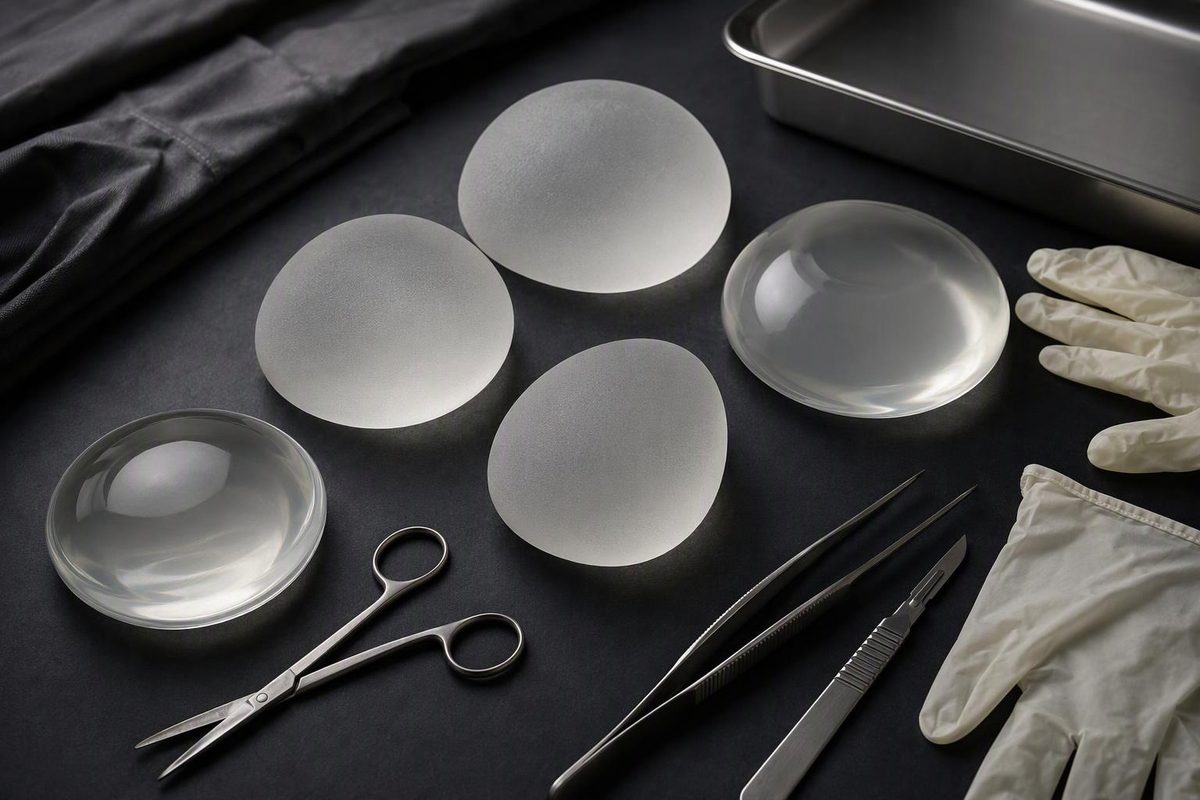
A 700 cc breast implant has a nominal volume of 700 cubic centimeters, or 0.7 liter. In bilateral surgery, “700 cc implants” usually means one 700 cc implant in each breast—not 700 cc divided between both sides.
That number describes volume only. It does not reveal the implant’s diameter, projection, gel firmness, placement or the cup size it will produce. On a narrow chest, accommodating that volume may require a narrower, higher-profile implant that projects farther forward. A broader implant can distribute a similar volume across a wider base.
What are the dimensions of a 700 cc implant?
Dimensions depend on the manufacturer, product line and profile. These catalog examples—not a statement about current availability—show how two 700 cc smooth, round silicone implants compare:
- Mentor MemoryGel Xtra, high profile (SHPX-700): 14.1 cm diameter and 6.5 cm projection
- Natrelle INSPIRA SoftTouch, extra-full profile (SSX-700): 14.25 cm width and 6.6 cm projection
Those measurements are about 5.6 inches wide with 2.6 inches of projection before placement. They are device specifications, not a forecast of how far the finished breast will project from the chest.
Volume alone leaves a wide range of possible dimensions. In the same Mentor catalog, a 700 cc moderate-plus implant is 15.8 cm wide with 4.9 cm projection, while a 700 cc ultra-high-profile implant is only 13.3 cm wide but projects 6.5 cm. The catalog also cautions that individual implant dimensions can vary slightly (Mentor product catalog). Natrelle’s chart similarly lists a nearby 685 cc moderate-profile implant at 16 cm wide with 5.2 cm projection, compared with its narrower, more projecting 700 cc extra-full model (Natrelle matchup guide).
Ask for the exact catalog number rather than assuming every 700 cc implant has the same shape. The essential specifications are:
- Fill volume in cc
- Base width or diameter in cm
- Projection in cm
For a shaped implant, height is a fourth important measurement.
What cup size will 700 cc produce?
There is no reliable “700 cc equals a ___ cup” conversion. Bra cups are not standardized across brands, and an implant adds to the breast tissue already present. Band size, chest width, starting volume, skin stretch, implant profile and placement all affect the eventual bra fit and appearance.
A study involving 32 participants and 10 plastic surgeons illustrates the problem. Surgeons estimated cup sizes from 3D torso scans, but agreement between their estimates and the cup sizes participants reported wearing was low. The researchers concluded that cup-size language can cause miscommunication in breast surgery (Plastic and Reconstructive Surgery—Global Open).
Rather than requesting 700 cc because an online photo carries that label, bring examples of results that look too small, too large and close to your goal. The American Society of Plastic Surgeons recommends using photos to clarify preferences and notes that frame, skin quality, breast shape and existing tissue all change how an implant looks (ASPS). In-office sizers or 3D simulation may add context, but neither can guarantee the postoperative result.
Is 700 cc too large?
There is no universal cutoff. The useful question is whether a particular 700 cc model fits the measured breast and available tissue coverage without requiring an unsuitable pocket or producing a shape the patient does not want.
A systematic review summarized by ASPS found stronger support for implant-selection systems based on breast and tissue measurements than for selection based on patient or surgeon preference alone. However, the evidence was limited: only four of the 33 included studies reported outcomes that could be compared with a standard, and none directly compared two or more sizing systems (ASPS). A consultation should therefore include measurements of breast-base width, tissue thickness, skin stretch and asymmetry—not only a discussion of cc.
Placement changes the tradeoffs but does not make an implant anatomically suitable by itself. An implant partly under the pectoral muscle can add upper implant coverage, while an over-muscle implant avoids pectoral movement; compare those issues in breast implants under vs over muscle.
Long-term tissue effects should also be part of the discussion. The FDA lists tissue thinning, implant visibility or palpability, displacement, sagging, rippling and dissatisfaction with size among possible implant complications. FDA-hosted Mentor patient labeling also says implant pressure may contribute to breast-tissue thinning and chest-wall deformity (FDA complications overview; FDA-hosted Mentor patient labeling). These sources do not establish a special risk threshold at 700 cc. The question is how the proposed implant’s dimensions interact with the individual breast, skin and chest wall.
Questions to take to the consultation
- What are the exact width, projection and catalog number of the 700 cc model you propose?
- How does its width compare with my measured breast base?
- What tissue-thickness and skin-stretch findings support this size?
- Would a different profile give the shape I want at a lower volume?
- How could this size affect implant visibility, downward displacement (“bottoming out”), sagging or future revision?
- Would I need a lift to address breast position rather than trying to solve it with more volume? See breast lift vs augmentation.
- Can I compare 700 cc with the next smaller sizes using sizers and standardized views?
- If my breasts differ, do you recommend different implant volumes or another technique?
- What would downsizing or removal involve if I later find the implants too large?
Breast implants are not lifetime devices. The FDA advises patients to assume they may eventually need additional surgery and identifies capsular contracture, reoperation and implant removal as common local outcomes (FDA). The size decision should therefore include the possibility and cost of future care, not only the initial appearance.