
Breast Implant Scars: Locations, Healing, and Treatment
Compare breast implant scar locations, healing timelines, aftercare, warning signs, and treatments for scars that remain raised or widen after surgery.
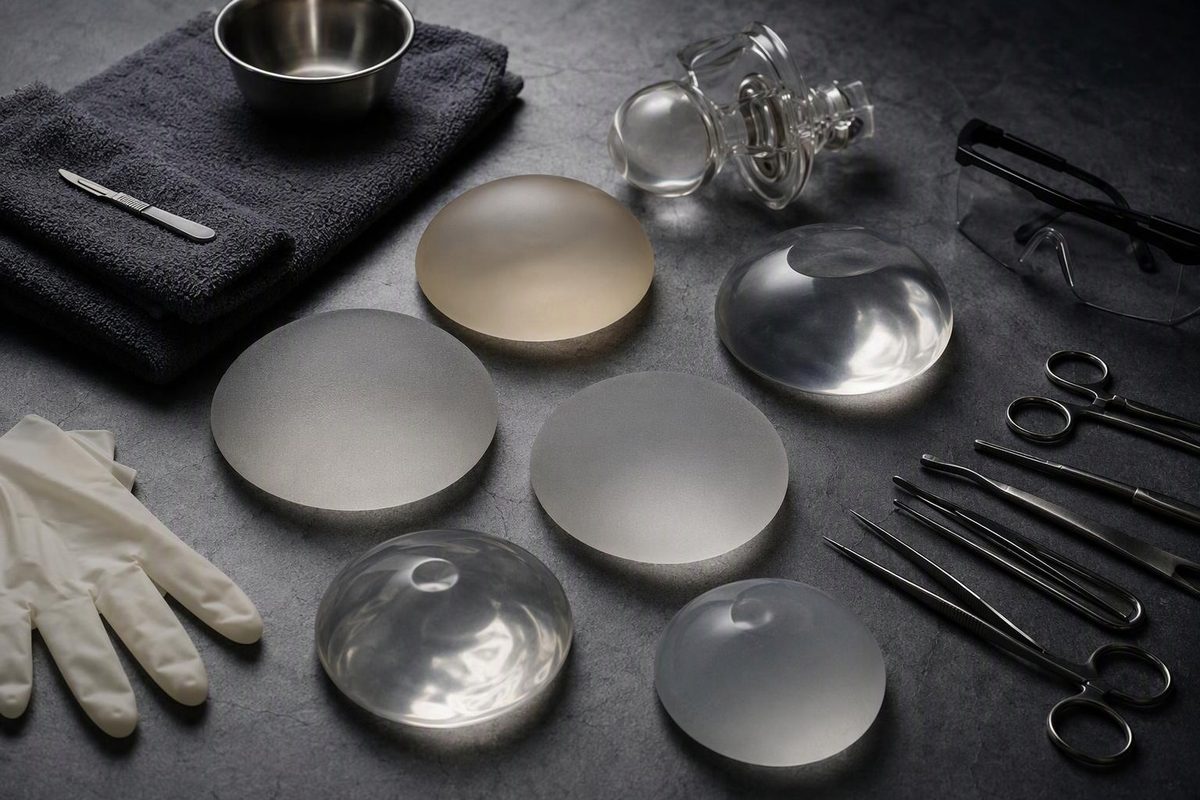
Breast implant surgery always leaves at least one skin scar. In cosmetic augmentation, the incision commonly sits in the breast crease, around the areola or in the armpit. Reconstruction, a breast lift or implant revision may create longer or additional scars.
No surgeon can promise that a scar will disappear. A well-healed scar may eventually become a thin, pale line, but its final width, color and texture depend on incision placement, tension, wound healing and a person’s tendency to form raised scars.
Choose the planned operation to compare its likely scar locations and tradeoffs.
Breast Implant Scar Planner
Planned operation
Likely pattern: Implant-only augmentation commonly uses a crease, areola-border or armpit incision.
Implant-Only Incisions
| Approach | Scar position | Main tradeoff |
|---|---|---|
| Inframammary | Breast crease | Direct pocket access; may show if the breast is lifted |
| Periareolar | Areola border | Color border may disguise it; discuss sensation and breastfeeding |
| Transaxillary | Armpit crease | No breast scar; may show with the arm raised |
Implant-With-Lift Patterns
| Pattern | Scar position | Main tradeoff |
|---|---|---|
| Areolar | Around the areola | Permanent line that generally fades |
| Vertical | Areola plus line to crease | More skin can be reshaped, with more scarring |
| Crease added | Areola, vertical line and crease | Longest of the listed lift patterns |
Reconstruction Scar Sources
| Part of surgery | Scar area | What determines it |
|---|---|---|
| Mastectomy | Breast | Mastectomy approach and remaining skin |
| Implant placement | Breast | Timing and available tissue coverage |
| Tissue flap | Breast and donor site | Whether tissue comes from the abdomen, back, thigh or buttock |
Source: ASPS incision and breast-lift guidance and NCI breast-reconstruction guidance cited in the article.
Common Breast Implant Incision Locations
| Incision | Scar location | Practical tradeoff |
|---|---|---|
| Inframammary | In or near the crease beneath the breast | The breast can cover the line while standing, although it may show when the breast is lifted or when lying down. The incision gives the surgeon direct access to the implant pocket. |
| Periareolar | Along part of the border between the areola and surrounding skin | The color transition may help disguise the line, but the scar remains on the breast. Discuss possible changes in nipple sensation and breastfeeding. |
| Transaxillary | In a crease of the armpit | Avoids a scar on the breast itself but leaves an underarm scar that may show when the arm is raised. Some later corrections may require another incision. |
These are three common cosmetic augmentation approaches described in the ASPS incision overview. They are not the only possible incisions.
Implant size and type, anatomy, the planned implant pocket and the surgeon’s technique can limit which approaches are reasonable. The least visible-sounding scar is not necessarily the best or safest route for a particular operation.
A Breast Lift Creates More Skin Scarring
Implants add volume but do not remove substantially loose skin. When a lift is performed with augmentation, the possible patterns include a scar around the areola; a scar around the areola with a vertical line to the breast crease; or those lines plus a horizontal crease incision.
ASPS notes that breast-lift incision lines are permanent, although they generally fade over time (ASPS breast-lift procedure). Compare this tradeoff before deciding between an implant and a breast lift or combined operation.
Reconstruction Requires an Individual Scar Plan
Scarring after implant reconstruction depends on the mastectomy, the timing of reconstruction and whether tissue from another part of the body is needed. Reconstruction using tissue from the abdomen, back, thigh or buttock also leaves a donor-site scar.
The National Cancer Institute notes that enough skin and muscle must remain after mastectomy to cover an implant, while tissue-flap reconstruction leaves a scar where the tissue is taken (NCI reconstruction guide). Radiation and previous operations can also affect the reconstructive plan and wound healing.
Breast Implant Scars Change for Months
A new incision may initially be pink, red, darker than the surrounding skin, slightly raised or firm. It can become more noticeable before it improves. A scar that remains dark, pink or firm early in healing is not necessarily abnormal.
Scar remodeling continues for many months. ASPS patient information describes a process lasting several months to more than a year (ASPS scar guidance). Breast-reconstruction guidance notes that some scars take up to two years to settle (North Bristol NHS Trust).
A typical scar gradually becomes softer, flatter and paler. Other healing patterns include:
- a hypertrophic scar, which becomes raised and thick but remains within the original wound area;
- a keloid, which grows beyond the wound’s borders; or
- a stretched scar, which becomes wider, often where tension pulls on the healing line.
A clinician may need to examine a raised scar to classify it correctly. Tell the surgeon before surgery if you or a blood relative forms keloids, and show how previous cuts or operations healed. Keloids cannot always be prevented, but early planning and treatment may reduce the risk (American Academy of Dermatology).
Scar Care Starts After the Incision Closes
The safest care plan is the one matched to the closure, dressings and healing progress. Do not put gel, oil, adhesive sheets or makeup on an open incision unless the surgical team specifically directs it.
- Protect the closure. Follow instructions for dressings, surgical tape, showering, bras, arm movement and lifting. Limiting excess tension while the wound is weak may help prevent widening.
- Wait for approval before massage. Massage is generally reserved for a fully closed incision. Timing varies, especially after reconstruction, delayed healing or radiation.
- Ask about silicone gel or sheets. Dermatologists use silicone after a wound closes to prevent or treat raised scars, but sheets can cause a rash or skin breakdown (AAD scar treatments).
- Limit sun exposure. Once the wound has healed, cover the scar or use broad-spectrum SPF 30 or higher when it may be exposed. Ultraviolet light can darken a new scar.
- Keep follow-up appointments. Request an earlier review if the scar is becoming progressively raised, itchy, painful or wider rather than simply maturing.
Expectations for silicone should be measured. A Cochrane review found low- or very-low-certainty evidence when silicone gel sheeting was compared with most alternatives for existing hypertrophic scars (Cochrane review).
Vitamin E, onion extract and other over-the-counter ingredients are not automatically better than simple care. The AAD reports that research on several nonprescription scar-treatment ingredients is limited, and topical products can irritate the skin.
Infection and Wound Opening Need Prompt Review
Contact the surgical team promptly for increasing redness, heat, swelling or pain; yellow or green drainage; fever; or an incision that opens. These can indicate infection or wound breakdown rather than ordinary scar maturation (Guy’s and St Thomas’ NHS guidance).
If the implant can be seen through broken skin, seek urgent assessment. The FDA defines this as implant extrusion (FDA implant complications).
Once the wound is stable, treatment for a bothersome raised, discolored, painful or itchy scar may include silicone, corticosteroid injections, laser or light treatment, or surgical revision. The choice depends on the scar type, symptoms and maturity.
Cutting out a scar creates a new wound, and a keloid can return. Surgical revision is therefore not automatically the first or best option.
A Skin Scar Is Not Capsular Contracture
The visible incision scar is different from the internal capsule—the layer of scar tissue the body forms around an implant. If that capsule tightens, the breast may become firm, painful or distorted. This is called capsular contracture.
The FDA lists capsular contracture separately from skin scarring and notes that treatment may require another operation. A normal-looking skin incision therefore does not rule out an internal implant problem.
Learn the early signs of capsular contracture, and have new breast firmness, shape change, swelling or persistent pain assessed rather than treating it as a surface scar.
Before surgery, ask the surgeon to mark the proposed incision while you are standing. Ask how its position could change as the implant settles and request healed results from patients with similar anatomy and skin tone. Also ask whether a future implant exchange or removal could reuse that line—or require another one.