
Should I Ask My Surgeon for Motiva Implants? FDA Record Compared
Motiva's FDA approval dates from September 2024 and covers augmentation only. See how that record compares with Mentor and Natrelle before your consult.
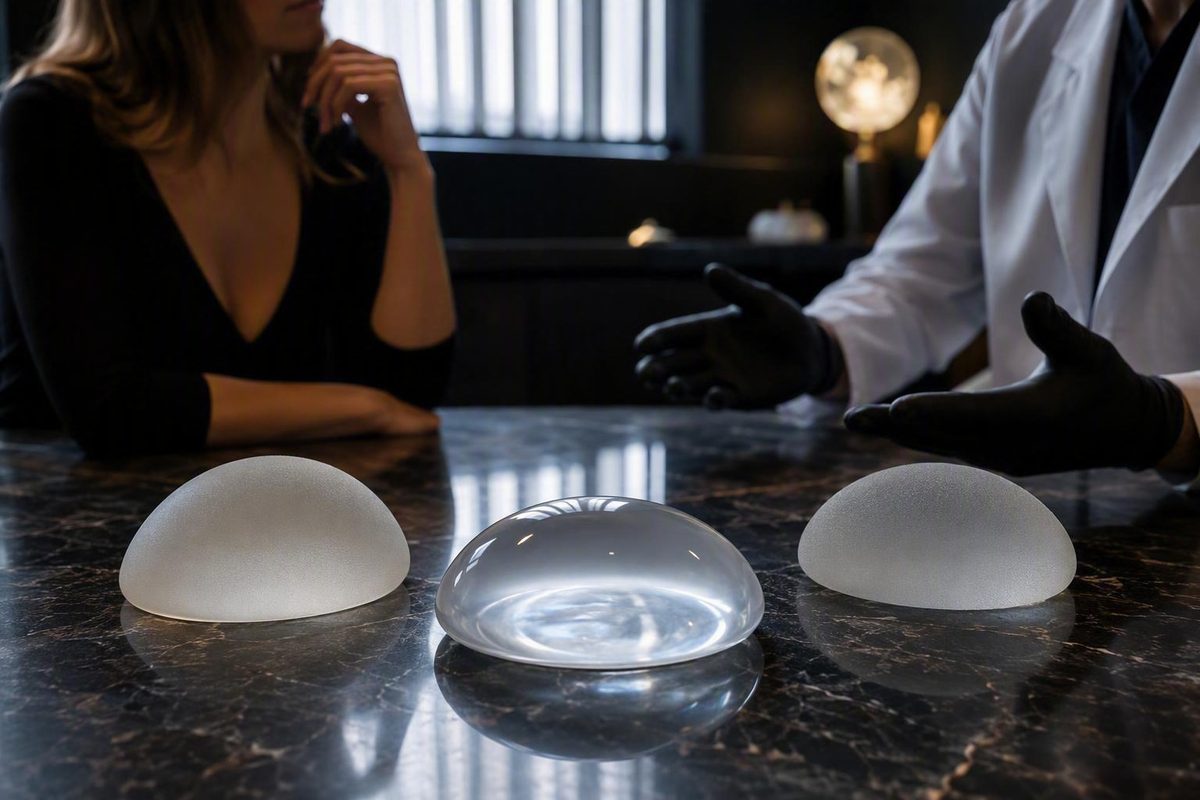
Yes, ask. A brand request is a fair way to open a consult, but the FDA record gives Motiva no ranking over its rivals. The agency approved Motiva SmoothSilk implants on Sept. 26, 2024, for primary and revision augmentation in women 22 and older, and that record does not list reconstruction. Mentor MemoryGel has held FDA approval since 2006 for both augmentation and reconstruction.
So the question to bring is narrower than “Can I have Motiva?” It is: “Why would this exact Motiva model fit me better than the other approved implants that also fit my anatomy and goals?”
FDA approval makes a specified implant available for specified uses. It does not show that the implant is safer, better or right for you.
Tick what applies to you; the table re-ranks and your question list updates.
FDA Approval Records Side by Side
Silicone gel lines with a record cited in this article. Tick what applies; rows re-rank and the question list changes.
What the records show
Oldest first: Mentor MemoryGel and Natrelle date from 2006; Motiva SmoothSilk from Sept. 26, 2024. Only Mentor's record in this table is confirmed to list reconstruction.
Questions to take to your surgeon
- Which exact model, profile and size are you proposing, and which FDA approval (PMA number) covers it?
- Is my operation (primary augmentation, revision or reconstruction) listed in that implant's current FDA labeling?
- Which other approved implants fit my measurements, and why are you not choosing them?
- Reconstruction: Motiva's record lists augmentation only. If I need reconstruction later, which implant would you use, and would that mean changing brand?
- Reconstruction: Can you show me the labeling page that lists reconstruction for the implant you would use?
- Track record: How long is the follow-up in the studies you rely on for this exact model, and how much of it is U.S. data?
- Track record: How many of this exact model have you placed, and what are your own contracture, rupture and reoperation numbers, with the follow-up period for each?
Aug. = augmentation indication in the FDA record. Recon. = reconstruction indication.
| Implant line | FDA decision | Aug. | Recon. |
|---|---|---|---|
| Mentor MemoryGel | 2006 | Listed, age 22+ | Listed, any age |
PMA number, age and yearsPMA P030053. Minimum age: 22 for augmentation; any age for reconstruction. Covers primary and revision procedures for both uses. Years since FDA decision: ~20. Source: FDA PMA record P030053. | |||
| Natrelle silicone gel | 2006 | — | — |
PMA number, age and yearsPMA P020056. Minimum age: —. Indication wording was not verified for this table; read FDA PMA record P020056 or the current Natrelle labeling before relying on it. Years since FDA decision: ~20. | |||
| Motiva SmoothSilk | Sept. 26, 2024 | Listed, age 22+ | Not listed |
PMA number, age and yearsPMA P230005. Products named: SmoothSilk Round and Round Ergonomix. Minimum age: 22. Covers primary and revision augmentation; reconstruction is not listed. Years since FDA decision: ~2. Source: FDA PMA record P230005. | |||
Not checked against FDA records for this table: Mentor MemoryShape, Natrelle 410, Sientra OPUS (dates and indications —). Look each up in the FDA labeling directory.
Sources: FDA PMA database records P230005, P030053 and P020056; FDA approved breast-implant labeling directory. — = not verified here. ~ = rounded. Time since approval is not a safety ranking.
Motiva’s 2024 Approval Covers Augmentation, Not Reconstruction
Motiva’s U.S. approval sits under PMA P230005, granted on Sept. 26, 2024. The record is titled for Motiva SmoothSilk Round and Round Ergonomix silicone gel-filled implants. It covers primary breast augmentation and revision augmentation in women at least 22 years old, according to the FDA’s P230005 record. Reconstruction does not appear as an indication.
That gap matters if you are having reconstruction now or could need it later. A clinic’s statement that “Motiva is FDA approved” does not establish that a reconstructive use appears in this approval. Ask the surgeon to name the product, the current labeling and the indication that matches your operation.
Mentor MemoryGel shows how far indications can differ between silicone gel lines. The FDA’s P030053 record lists primary and revision augmentation in women 22 or older, plus primary and revision reconstruction at any age. That does not make Mentor better for reconstruction or Motiva better for augmentation. It means the label, not the brand, tells you what the FDA reviewed.
Natrelle’s silicone gel line is the other 2006 approval, filed under PMA P020056. This article did not verify that record’s indication wording, so it appears as a dash in the table above. Read the record or ask the surgeon to show you the labeling.
The Motiva approval also stops at the named products. FDA-approved patient information covers SmoothSilk Round and SmoothSilk Round Ergonomix implants for augmentation. It does not extend to every Motiva product, profile, surgical technique or device sold in another country. The FDA’s approved breast-implant labeling directory holds the current patient materials for each approved line.
Before you agree to surgery, get these in writing: the complete product and model name, whether it is Round or Ergonomix, its profile, width, projection and volume, its surface description, whether it contains an RFID microtransponder, and whether your operation is primary augmentation, revision augmentation or reconstruction.
Demand for Motiva Is Growing Faster Than Its U.S. Record
An implant approved in 2006 has had about two decades to accumulate U.S. follow-up. One approved in late 2024 cannot have that yet, whatever its history abroad. Time since approval limits how long domestic follow-up can be; it is not a safety score in either direction.
Patient demand has not waited. Establishment Labs reported second-quarter 2026 U.S. sales of $24.7 million, up 26% from the first quarter, in its SEC-filed earnings release. On the earnings call, management said Motiva passed 100,000 U.S. implants less than 21 months after launch, and that 75% of surgeons see patients asking for a brand, with 93% of those naming Motiva, per the Yahoo Finance call summary.
Those are company figures. The call summary gives no survey methodology, so the request numbers cannot be read as clinical evidence. The same release cites millions of Motiva devices delivered globally and describes Preservé as “tissue-preserving” and “minimally invasive.” Those are manufacturer characterizations. They do not establish less pain, faster recovery, lower risk or suitability for every patient.
Adoption shows interest. It cannot show whether an implant fits your anatomy or produces better outcomes.
The Published Motiva Evidence Is Mostly Retrospective and Manufacturer-Linked
The sources reviewed for this article include no head-to-head trial ranking Motiva against Mentor or Natrelle. Cross-study comparisons are especially unreliable when the studies use different patient populations, definitions, surgical techniques or follow-up periods.
A published systematic review included 13 studies involving 4,784 patients and reported 250 complications, or 5.2%. Early seroma was reported at about 1.08%, early hematoma at about 0.54% and capsular contracture at about 0.54%.
The limits are as important as the rates. Follow-up ranged from 4.2 to 72 months. Ten of the 13 studies were retrospective, seven originated in Korea, and eight involved manufacturer funding or an author with a financial relationship to the manufacturer. The authors concluded the evidence was insufficient to establish safety or superiority and called for larger prospective, multicenter controlled studies. No BIA-ALCL cases were observed, which cannot establish zero risk for a rare outcome.
When a clinic quotes a complication rate, ask:
- Which exact complication does the percentage describe?
- How many patients or implants were included?
- How long were they followed, and how many were lost to follow-up?
- Were they primary-augmentation or revision patients?
- Was the study prospective, retrospective, controlled or manufacturer-funded?
- Does the comparison use the same definitions and follow-up period?
“The complication rate is under 1%” is not an answer. Contracture, rupture, infection, seroma, malposition and reoperation are different outcomes, and a low rate for one does not describe the others.
Anatomical Fit Decides the Implant, Not the Brand
Implant volume is one measurement. Two implants with the same volume can differ in width and projection, so selection has to account for chest measurements, the natural breast footprint, existing tissue, skin characteristics, asymmetry and the result you want. Consultation guidance from the American Society of Plastic Surgeons says to discuss shape, size, surface, incision and placement rather than choosing by brand or cup size.
Cup size is a poor target because bra sizing does not specify implant dimensions. Ask which width and profile fit your measurements, and what you trade by going wider, narrower, larger or smaller.
Motiva’s approved line comes as Round and Round Ergonomix. Whatever a brochure says about how each one moves or feels is a product description, not independent proof that either looks more natural or produces better outcomes for every patient.
Incision and placement are separate surgical decisions. Ask which incision and pocket location the surgeon recommends, what alternatives are reasonable, and how each changes the operation. A brand name answers none of that.
Have the surgeon fill in the same line items for the Motiva proposal and for the best suitable alternative: exact model, width, projection, volume and profile, placement, incision, expected visual tradeoffs and the rationale. If sizers are offered, try them, but treat them as planning aids rather than guarantees. Review before-and-after photographs of patients with similar starting anatomy, implant dimensions and placement; a result from someone with a different chest or tissue is a weak forecast.
Then ask what would change the recommendation. A different width might fit the breast footprint better. A smaller volume might meet the plan. Would a lift address loose skin more directly? Fat transfer might meet a modest volume goal. A recommendation is stronger when the surgeon can state its limits.
Strong Answers Name a Model, a Measurement and an Alternative
| Question | A Useful Answer Includes | Warning Sign |
|---|---|---|
| Which exact implant and indication? | Full model name, profile, size, surface, labeling and proposed use | “Motiva is FDA approved” with no product or use named |
| Why does it fit my anatomy? | Chest and breast measurements, tissue coverage, skin, asymmetry, projection | A recommendation based only on cup size |
| What alternatives also fit? | Other models, profiles, sizes, fat transfer, or no surgery | Refusal to discuss another suitable option |
| What evidence supports it? | Population, denominator, follow-up, primary versus revision | A single percentage without context |
| What is your experience? | Case numbers for this exact model and defined personal outcomes | General implant experience passed off as model-specific |
| What happens over time? | Monitoring, complication management, removal, replacement, revision | An implication that the implant lasts for life |
| What is the total cost? | Surgery, imaging, follow-up, warranty limits, possible revision | A package price with exclusions left unwritten |
A persuasive recommendation explains why Motiva fits and why another plausible option fits less well. A surgeon’s willingness to discuss alternatives, uncertainty and personal outcome data tells you more than enthusiasm for any brand.
Every Brand Carries a Reoperation Risk
Breast implants are not lifetime devices. The longer they stay in place, the greater the chance of complications, some of which require more surgery, even when the first operation and early recovery go well.
The problems to discuss by name are rupture, capsular contracture, infection, seroma, malposition or asymmetry, rippling or palpability, and dissatisfaction with size or appearance. Any of them can lead to replacement, removal without replacement, or another reoperation.
Ask how the surgeon would identify and manage each one. Which symptoms should prompt an examination? Ask what imaging might be ordered, when observation is reasonable, who would perform a revision, and which surgeon, anesthesia, facility, implant, imaging and travel costs could fall to you.
The FDA-approved Motiva patient labeling says BIA-ALCL occurs more commonly in patients with textured implants than smooth implants, although rates are not well defined. It also notes reports of systemic symptoms including joint pain, muscle aches, confusion and chronic fatigue; individual risk and causation have not been well established. Some patients report improvement after implant removal, but that does not predict an individual outcome.
Ask for the surgeon’s own outcomes reported separately for primary and revision augmentation, because the two groups are not interchangeable. Ask how surgery might affect breastfeeding, how pregnancy, aging or weight change could alter the result, what your options are if you dislike the appearance, and what your breasts might look like after removal without replacement.
Request the complete current patient labeling rather than a promotional summary, and leave time for follow-up questions before you consent.
MRI Conditions, Warranty Limits and Lifetime Cost
Treat breast implants as a long-term ownership decision rather than a one-time purchase. Expenses may include follow-up appointments, imaging, evaluation of symptoms, revision, replacement or removal.
Request the current written surveillance schedule for the exact implant. Confirm when imaging should begin, which method is recommended, how often it repeats, where it can be done and whether your insurance is likely to cover it. Do not rely on an old general schedule when model-specific labeling exists.
If the proposed implant contains an RFID microtransponder, get the exact MRI conditions from the current labeling and give them to the imaging facility. FDA-approved labeling says RFID-equipped Motiva implants may be scanned only under specified conditions. Have the imaging center confirm it can follow them before the appointment.
A warranty is financial protection, not evidence that an implant is safer, more durable or less likely to need surgery. Get it in writing and find out which complications qualify, how long each benefit lasts, whether registration is required, and whether the benefit supplies only a replacement implant or also contributes to surgeon, anesthesia and facility fees. Check whether imaging, medication, garments, travel and time off work are excluded, whether removal without replacement earns any benefit, and which records or tests a claim requires.
The initial quote should be itemized: implants, surgeon’s fee, anesthesia, facility, preoperative testing, garments, prescriptions, routine follow-up, additional imaging, treatment of complications, and possible revision, replacement or removal. This article has no price figures for any of these lines.
Compare total ownership costs only among implants that are anatomically suitable. A lower initial price may exclude imaging or future surgery, while a broad-sounding warranty may provide little more than a replacement device.
Verify the Surgeon and Facility Yourself
The ASPS consultation checklist says to confirm that the surgeon is certified by the American Board of Plastic Surgery, trained specifically in plastic surgery, holds appropriate hospital privileges and has relevant breast-surgery experience. Confirm that the operating facility is accredited, state-licensed or Medicare-certified as applicable, and ask who will administer anesthesia.
Do not rely on a practice biography or the words “board-certified” alone, because the certification may be in another medical field. Verify the named board independently, and ask the facility which organization accredits it.
Three Motiva Terms Patients Mix Up
Preservé Marketing Language Is Not an Implant Specification
The FDA approval record is titled for SmoothSilk Round and Round Ergonomix implants. The company’s “tissue-preserving” and “minimally invasive” wording for Preservé describes an operation, not implant dimensions. Ask which exact implant would be used, and evaluate the implant, incision, placement, anesthesia and evidence separately. Practice and manufacturer descriptions of Preservé are not independent proof of safer surgery, less pain, faster recovery or suitability for every patient.
The Motiva Implant Matrix Is a Sizer, Not the Permanent Implant
The FDA issued a 510(k) substantial-equivalence determination for the sizer in 2019, according to the FDA clearance document. That clearance did not establish clinical superiority for permanent Motiva implants.
An RFID Microtransponder Is Not a Safety Feature
Nothing reviewed here shows that an RFID microtransponder reduces rupture, contracture, infection, malposition or reoperation. If the proposed implant contains one, get the exact device information and MRI conditions in writing and pass them to the imaging facility before a scan.
This is general information, not medical advice; the decision belongs in a consultation with a qualified, board-certified plastic surgeon.