
450 cc Breast Implants: Size, Profile and Fit
A 450 cc implant has no fixed cup size. Compare actual width and projection, nearby volumes, tissue fit and long-term silicone implant screening.
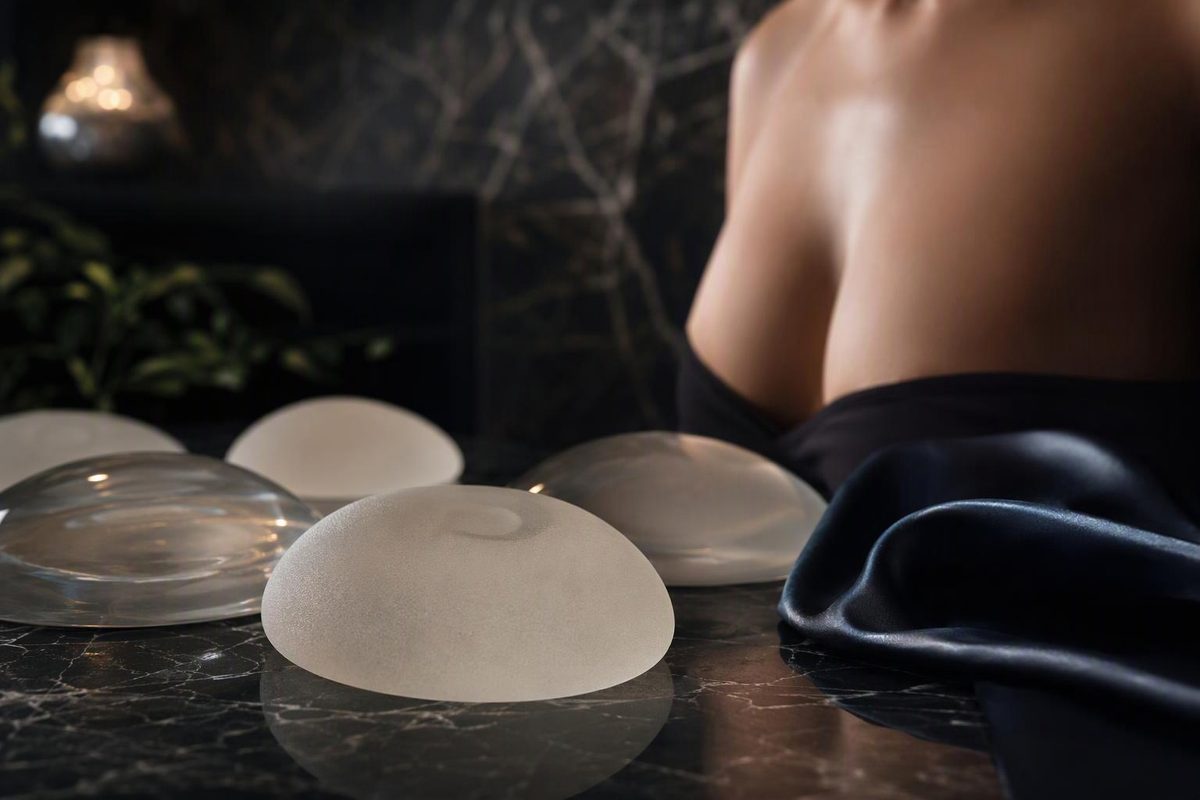
A 450 cc implant contains 450 milliliters of filling—0.45 liter. That number describes one implant’s volume, not your final breast size. If both implants are 450 cc, each breast receives that volume; it is not divided between the two breasts.
There is no reliable conversion from 450 cc to a C, D or DD cup. The more useful questions are how wide the implant is, how far it projects forward, and how those dimensions fit your existing tissue and goals.
What cup size will 450 cc give you?
The same implant volume can look different on different people. Your frame, natural breast tissue, skin quality and breast shape all contribute to the result. Bra cup sizing also varies by brand, so a promise such as “450 cc equals a D cup” is not a dependable sizing guide. ASPS explains these limits.
For the same reason, a before-and-after photo labeled “450 cc” is a reference, not a prediction. Bring examples of results you like and dislike, explaining whether you mean overall size, upper-breast fullness or side-view projection. Those distinctions are more useful than asking for a particular cup letter.
Two 450 cc implants can have different dimensions
Profile describes an implant’s projection relative to its base width. Higher-profile implants generally concentrate a similar volume into a narrower base with more forward projection. But the profile name alone is not enough: product lines can differ even within one manufacturer.
For example, Mentor’s 2020 catalog lists these smooth, round silicone implants:
| Implant model, all 450 cc | Base diameter | Projection |
|---|---|---|
| MemoryGel Moderate Plus, 350-4501BC | 13.6 cm | 4.2 cm |
| MemoryGel High, 350-4504BC | 12.8 cm | 5.1 cm |
| MemoryGel Xtra High Profile, SHPX-450 | 11.9 cm | 5.9 cm |
These are model-specific examples from the manufacturer’s dated catalog, not dimensions for every 450 cc implant or a statement of current availability. The catalog also notes that individual implant dimensions may vary slightly. Confirm the current specifications of the device your surgeon proposes.
The same volume can occupy a wider, shallower shape or a narrower, more projecting one. Catalog projection measures the implant itself; it does not tell you exactly how far your postoperative breast will project.
Ask your surgeon to write down the proposed brand, product line, model number, shell surface, diameter and projection, rather than only “450 cc high profile.” Our moderate-versus-high-profile comparison explains that tradeoff in more detail.
Comparing 400, 450 and 500 cc
Moving from 400 to 450 cc adds 50 milliliters per implant; moving from 450 to 500 cc adds another 50. Neither step guarantees a particular change in cup size or appearance.
Here is how those volumes compare within one profile in the same Mentor 2020 catalog:
| Smooth, round MemoryGel Moderate Plus | Base diameter | Projection |
|---|---|---|
| 400 cc | 13.1 cm | 4.0 cm |
| 450 cc | 13.6 cm | 4.2 cm |
| 500 cc | 14.1 cm | 4.3 cm |
In this historical, model-specific example, each 50 cc step adds 0.5 cm of diameter, but projection increases by 0.2 cm and then 0.1 cm. More volume does not simply mean more forward fullness. If 400 cc is your other leading option, see our 400 cc silicone implant guide.
At a sizing appointment, ask to compare nearby volumes within the same product line and profile where possible. Otherwise, you may be comparing a change in shape as well as volume. Bra inserts and 3-D imaging can help you visualize options, but they are simulations rather than guarantees of the surgical result. ASPS describes both tools.
Useful consultation questions include:
- What is my breast base width, and how does this implant’s diameter compare?
- How much tissue will cover the implant, and why do you recommend this placement?
- Which nearby volume best matches the result I want—and what would change if I chose 450 cc?
- If I have sagging, do I need a lift rather than more implant volume?
An implant adds volume but does not substitute for a lift when drooping breasts or low nipple position need correction. ASPS distinguishes these goals; see also breast lift versus augmentation.
Include long-term care in the choice
A 450 cc volume does not establish an implant’s safety or lifespan. Review the exact device’s patient booklet and decision checklist with a board-certified plastic surgeon. Risks include rupture, capsular contracture—tightening of scar tissue around the implant—sensation changes and additional surgery. Breast implants are not lifetime devices. FDA risk information applies beyond the initial sizing decision.
For silicone gel implants, U.S. FDA guidance recommends ultrasound or MRI for silent rupture starting 5–6 years after surgery, then every 2–3 years, even without symptoms. This applies to cosmetic augmentation and reconstruction and does not replace any breast-cancer screening you need. FDA screening guidance.
New persistent swelling, pain or a lump should prompt medical evaluation rather than waiting for routine imaging. FDA describes symptoms requiring evaluation.
Before committing, request an itemized surgical quote and ask separately about future imaging and revision costs. The consultation should leave you with a specific implant plan, realistic appearance expectations and a follow-up plan—not just a cc number.