
Moderate vs High Profile Breast Implants: Width and Projection
Moderate implants are generally wider; high-profile implants project more at a similar volume. Learn which measurements to compare.
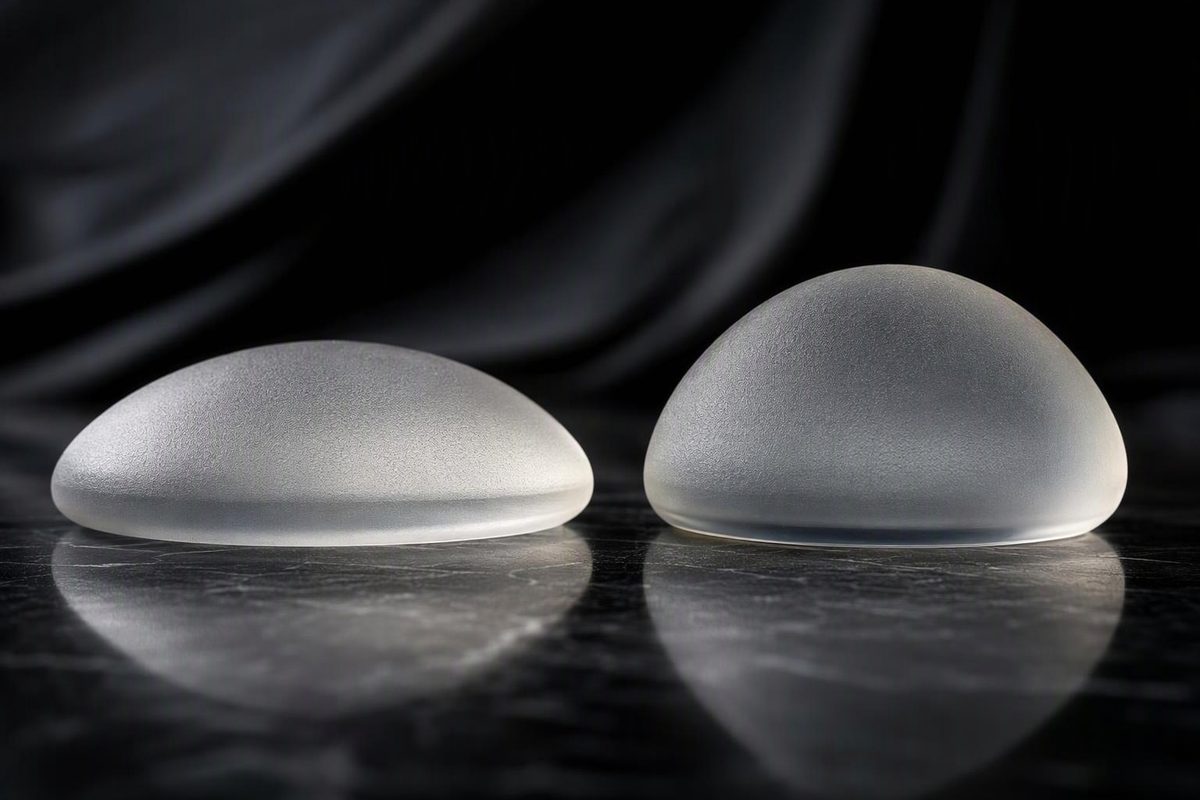
A moderate-profile breast implant is generally wider and projects less than a high-profile implant of similar volume. A high-profile implant places that volume into a narrower base with more forward projection.
That does not make moderate implants inherently more natural or high-profile implants inherently more dramatic. The result also depends on the implant’s exact dimensions, breast and chest measurements, tissue coverage, surgical pocket and the intended change.
The difference in practical terms
Three measurements help describe a round implant:
- Volume: how much the implant holds, stated in cubic centimeters (cc)
- Base diameter: the width of the implant where it sits against the chest
- Projection: how far the implant extends forward
“Profile” groups those dimensions into a manufacturer’s product category. At a similar volume:
| Feature | Moderate profile | High profile |
|---|---|---|
| Base diameter | Usually wider | Usually narrower |
| Forward projection | Usually lower | Usually greater |
| May suit | A plan needing more width and less forward projection | A plan needing a narrower base and more forward projection |
| Does not guarantee | A subtle or “natural” result | A round, obvious or “fake” result |
An American Society of Plastic Surgeons patient article gives the same basic geometric explanation: implants of equal cc volume can project differently because the implant with the smaller base width projects farther forward. It also notes that body proportions and the desired result matter (ASPS).
Why the profile name is not enough
Profile labels are not standardized across manufacturers. A peer-reviewed review found that implants with similar dimensions may be called “high,” “full” or “moderate-high” by different companies. It also distinguishes profile, a category describing the overall silhouette, from projection, a measurable distance in centimeters (Plastic and Reconstructive Surgery Global Open).
Even one manufacturer may offer moderate classic, moderate plus, high and ultra-high options. This is why “I want 350 cc, high profile” does not fully identify an implant. A useful comparison includes:
manufacturer and model + volume + base diameter + projection
The dimensions can differ substantially. In Mentor’s Australian catalog, for example, a 350 cc smooth round moderate-classic implant is listed as 12.5 cm wide with 3.9 cm projection. A 350 cc smooth round high-profile implant is 10.1 cm wide with 5.2 cm projection (Mentor product catalog). These figures illustrate the geometry, not a recommendation; model names and availability vary by country and can change.
The same principle becomes especially important with a large implant volume: cc alone cannot predict width, projection or cup size.
Which profile fits better?
The starting point is generally the measured breast and chest—not a profile label. FDA-approved patient labeling for one current implant line says selection should account for chest-wall dimensions, breast base width, tissue characteristics and projection. It warns that choosing an implant too large for the available chest or tissue can contribute to implant visibility or palpability (FDA-approved Motiva patient labeling).
A surgeon may therefore consider:
- The width of each breast and any natural asymmetry
- Chest-wall shape and the distance between the breasts
- Skin stretch and the amount of tissue available to cover the implant
- Nipple position and the existing breast crease
- The desired changes in breast width and forward projection
- Implant placement above or partly or fully below the pectoral muscle
- Whether loose skin or meaningful sagging calls for a lift rather than additional implant volume
Published tissue-based planning methods likewise assess breast and chest width, skin stretch and tissue thickness. The authors describe implant width and projection as key parameters rather than treating volume as the only sizing measure (peer-reviewed planning paper).
Moderate profile may be considered when
The planned implant needs a broader base and less forward projection at the chosen volume. A wider implant can add more width than a narrower implant of similar volume, but its base still needs to fit the available breast footprint.
High profile may be considered when
The plan calls for more forward projection within a narrower base diameter. This geometry can fit some narrower breast footprints, but a petite frame does not automatically require a high-profile implant. Tissue coverage and the measured breast base still matter.
High profile also does not independently determine upper-breast fullness or the final contour. Existing tissue, gel behavior, pocket position and healing all contribute. Compare over-muscle and under-muscle placement separately rather than treating profile as a substitute for placement.
Profile cannot correct every concern
An implant adds volume; it does not reliably lift a low nipple or remove loose skin. Choosing a larger implant to avoid lift scars can ask more of the skin without correcting meaningful sagging. Current FDA-approved patient labeling notes that larger implants may accelerate the effects of gravity on breast tissue and skin (FDA-approved Motiva patient labeling). If breast position is the main concern, compare a breast lift with augmentation.
For reconstruction, width and projection still matter, but sizing requires a separate assessment of the mastectomy skin envelope, available tissue, prior or planned treatment and symmetry goals. A rule intended for straightforward cosmetic augmentation should not be carried over without a reconstructive evaluation.
Ask to see the exact implant dimensions
At consultation, ask the surgeon to place the proposed options side by side on a written plan or current manufacturer chart. Useful questions include:
- What are the manufacturer, model and profile name?
- What are the volume, base diameter and projection in centimeters?
- How does the implant’s base diameter compare with each measured breast?
- Why is this profile preferable to the next wider or narrower option?
- What will profile change—and what will placement, gel characteristics or a lift change instead?
- Is this implant FDA-approved for my planned cosmetic or reconstructive use?
- Can I review the manufacturer’s patient labeling and FDA-required decision checklist before scheduling?
The FDA requires approved breast implants to have patient labeling that includes a decision checklist, boxed warning and device card identifying details such as the implanted style and size. The agency also emphasizes that implants are not lifetime devices and that additional operations may be needed (FDA consumer guidance). Keep the completed device card after surgery.
The choice is therefore not “moderate” or “high” in isolation. It is a specific implant whose measured width and projection fit the anatomy and the surgical plan.