
Silicone Implant Size Chart: Volume, Width and Projection
Compare silicone implant volumes, widths and projections in a manufacturer-based chart—and learn why cc cannot predict your final bra cup size.
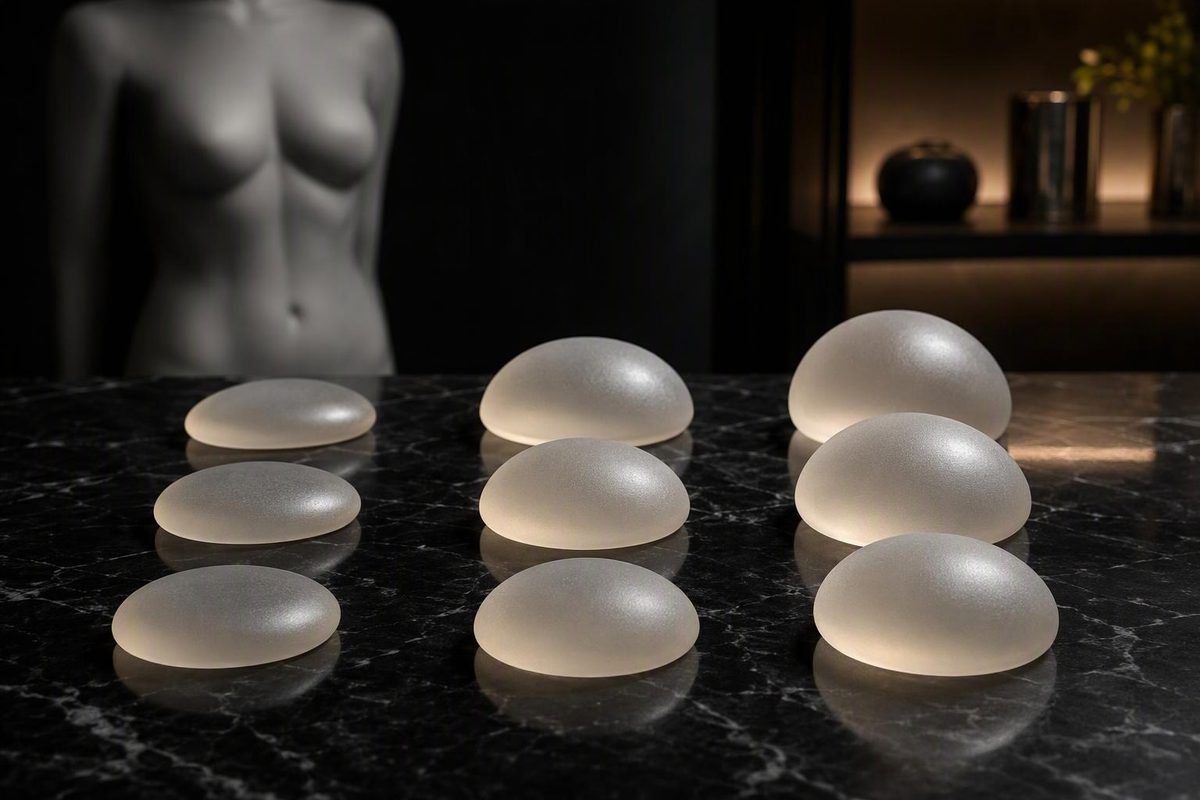
A useful silicone implant size chart shows volume, base width and projection—not a promised bra cup size. The same volume can come in a wider, flatter implant or a narrower implant that projects farther forward. Your existing breast tissue, skin and chest shape also affect the result. ASPS implant-selection explainer
Use the chart below to understand those differences, then ask a board-certified plastic surgeon which dimensions fit your anatomy and goals.
Silicone implant size chart
These examples are Mentor MemoryGel smooth round silicone implants, comparing Moderate Plus and High profiles. Each measurement pair lists diameter × projection, in centimeters. Volume is for one implant, not both breasts combined.
| Volume per implant | Moderate Plus: diameter × projection | High: diameter × projection |
|---|---|---|
| 200 cc | 10.5 × 3.2 cm | 9.7 × 4.0 cm |
| 250 cc | 11.3 × 3.4 cm | 10.5 × 4.3 cm |
| 300 cc | 12.0 × 3.6 cm | 11.1 × 4.5 cm |
| 350 cc | 12.5 × 3.9 cm | 11.7 × 4.8 cm |
| 400 cc | 13.1 × 4.0 cm | 12.2 × 5.0 cm |
| 450 cc | 13.6 × 4.2 cm | 12.8 × 5.1 cm |
| 500 cc | 14.1 × 4.3 cm | 13.2 × 5.3 cm |
| 550 cc | 14.6 × 4.5 cm | 13.6 × 5.5 cm |
| 600 cc | 15.0 × 4.6 cm | 14.0 × 5.6 cm |
| 650 cc | 15.4 × 4.8 cm | 14.4 × 5.7 cm |
| 700 cc | 15.8 × 4.9 cm | 14.8 × 5.8 cm |
| 750 cc | 16.3 × 4.9 cm | 15.1 × 5.9 cm |
| 800 cc | 16.5 × 5.1 cm | 15.5 × 6.0 cm |
Source: Mentor product catalog, effective January 2019, smooth MemoryGel tables on pages 7–8. The corresponding product codes are listed on J&J MedTech’s U.S. MemoryGel page. Individual implant dimensions may vary slightly; confirm the current specifications for the exact model offered.
This is a selected comparison, not a complete catalog or a recommended size range. It does not describe MemoryGel Xtra, BOOST, other manufacturers’ implants or every option used for reconstruction.
What the measurements mean
- Volume (cc): Cubic centimeters measure volume; 1 cc equals 1 milliliter. A 400 cc implant therefore has a labeled volume of 400 mL. Silicone gel implants contain a fixed volume, unlike saline implants that are filled during surgery. FDA labeling guidance
- Diameter or base width: The distance across the base of a round implant. It describes the implant’s footprint, not your final breast width.
- Projection: How far the implant extends forward from its base. It is a device measurement, not a prediction of how far your breast will project after surgery.
- Profile: The label describing the relationship between width and projection. Profile names vary by brand, so compare actual dimensions rather than names alone. ASPS implant-selection explainer
For example, the chart’s 400 cc Moderate Plus implant is 13.1 cm wide with 4.0 cm projection. The 400 cc High implant is 12.2 cm wide with 5.0 cm projection: 0.9 cm narrower and 1.0 cm more projecting, at the same volume. Neither is automatically the better fit.
Our moderate versus high-profile comparison explains this tradeoff in more detail.
Why there is no reliable cc-to-cup-size chart
A 350 cc implant does not reliably produce a C cup, and a 450 cc implant does not reliably produce a D cup. Bra cup sizing varies between brands, while your starting tissue, frame, skin quality and breast shape influence how an implant looks. Surgeons interviewed in an American Society of Plastic Surgeons explainer recommend communicating the desired appearance with photographs rather than relying on cup labels.
Treat online rules such as “a certain number of cc adds one cup size” as unsuitable for choosing your implant. They cannot establish your likely result.
Likewise, comparing 350 cc with 400 cc tells you there is a 50 cc volume difference—not whether that difference will create the change you want. For a closer look at that volume, see our 400 cc silicone implant guide.
How to use the chart at your consultation
Ask your surgeon to identify the exact brand, product line, profile and model code for each option. Then discuss:
- Fit: What are my breast base measurements, and why does this implant width suit them?
- Appearance: How will my existing tissue and skin affect the contour? Bring examples of results you like and dislike.
- Nearby options: What would change with a different volume or profile—not just a larger number of cc?
- Reconstruction: If this is after mastectomy, how do my remaining tissues and treatment history affect the options, and is this model indicated for reconstruction?
- Long-term care: What does the device-specific patient decision checklist say about complications, further surgery and monitoring?
Size is only part of the decision. Breast implants are not lifetime devices, and complications may require additional operations. For silicone implants without symptoms, FDA guidance recommends the first ultrasound or MRI for rupture screening at 5–6 years, then every 2–3 years. This applies to augmentation and reconstruction and does not replace breast-cancer screening appropriate to your medical history. Symptoms should be evaluated rather than waiting for the routine screening date; FDA guidance recommends MRI for suspected rupture when symptoms occur or ultrasound results are uncertain. FDA guidance